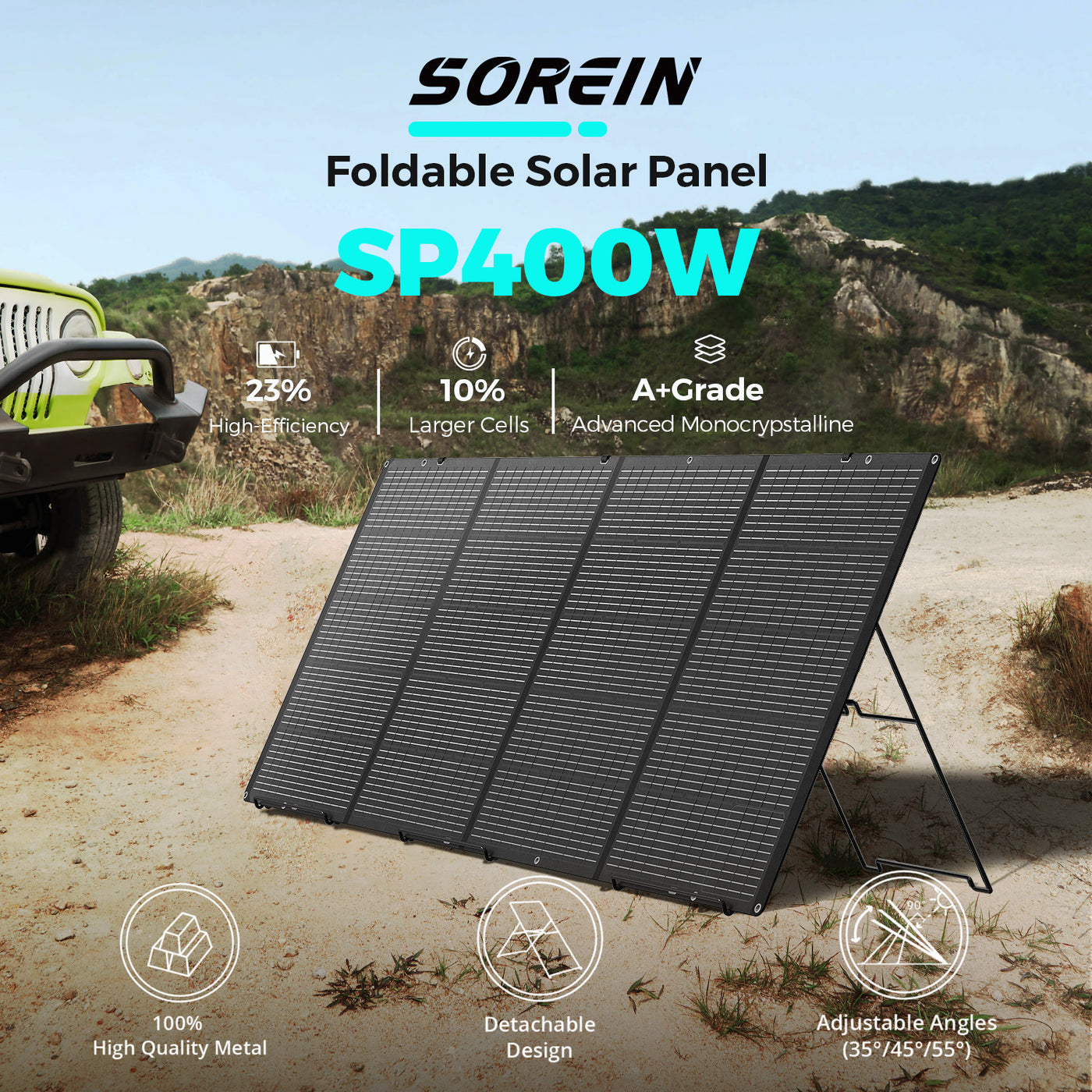
Both panels come off the same 2,510 × 982 × 2 mm sheet, fold to the same 620 × 982 × 35 mm and weigh the same 14.4 kg. The difference is the cell batch: 24% cell efficiency against 25%, which is where the extra 50W comes from without a bigger panel or a heavier case.
SP400 against SP450 — what the price difference buys
Specification
SP400
SP450
Price
$499
$599
Price per rated watt
$1.25/W
$1.33/W
Rated power
400W
450W
Cell efficiency
24%
25%
Dimensions (unfolded)
2,510 × 982 × 2 mm
2,510 × 982 × 2 mm
Folded size
620 × 982 × 35 mm
620 × 982 × 35 mm
Net weight
14.4 kg
14.4 kg
Put plainly: +13% rated power for +20% price, and $1.33/W against $1.25/W — about 6% more per watt. The SP450 earns its price when the panel count and the packing space are fixed; the SP400 stays the cheaper route to watts if you have room for another panel.
Full specifications
Panel figures reference STC: 25°C cell temperature, 1,000W/m² irradiance, AM1.5 spectrum. Every row carries a value in both columns — where the two read the same, it is physically the same part on either model.
400W / 450W Folding Solar Panel — documented specifications
Specification
SP400
SP450
Model No.
SP400W
SP450W
Rated power (Pmax)
400W
450W
Maximum power voltage (Vmp)
36.00V
36.00V
Maximum power current (Imp)
11.11A
12.05A
Open-circuit voltage (Voc)
40.32V
42.02V
Short-circuit current (Isc)
12A
13.13A
Cell type
Monocrystalline
Monocrystalline
Cell efficiency
24%
25%
Surface encapsulation
ETFE lamination
ETFE lamination
Fold quantity
4-fold
4-fold
Dimensions (unfolded)
2,510 × 982 × 2 mm
2,510 × 982 × 2 mm
Dimensions (folded)
620 × 982 × 35 mm
620 × 982 × 35 mm
Net weight
14.4 kg
14.4 kg
Gross weight
18.4 kg
18.4 kg
Packing size
107 × 75 × 14 cm
107 × 75 × 14 cm
Connector type
MC4 IP67 connectors
MC4 IP67 connectors
Output lead
1.5m integrated factory-fitted MC4 cable
1.5m integrated factory-fitted MC4 cable
Included adapter cable
DC5521, Anderson, XT60, Aviation M16
DC5521, Anderson, XT60, Aviation M16
IP rating
IP67
IP67
Operating temperature
−20°C to 60°C
−20°C to 60°C
Optimal temperature
77°F (25°C)
77°F (25°C)
Test condition (STC)
25°C, 1,000W/m², AM1.5
25°C, 1,000W/m², AM1.5
Warranty
1 year
1 year
Specifications shown are the documented configuration used for this guide. Ratings can vary by market; confirm the exact store listing before purchase.
Why neither panel reads its rated watts
Both ratings are measured under Standard Test Conditions (STC): 1,000 W/m² irradiance, a 25°C cell temperature and a fixed laboratory sun spectrum. Outdoors, four factors pull the real input down from either label — none of them is a defect, and they cost the same percentage on both panels.
Cell temperature. Monocrystalline cells lose roughly 0.35–0.45% of output for every °C above 25°C. A panel in direct sun on a warm day easily reaches 50–60°C at the glass, which alone cuts output by 9–16%.
Sun angle and irradiance. STC assumes direct overhead sun. Low winter sun, haze and thin clouds reduce what reaches the cells — hazy or partly cloudy conditions deliver 20–60% of rated watts, which is why the matrix below starts well under the labels.
Shading and soiling. Partial shade from a branch, roof rack or antenna can cut string output sharply, and dust or pollen on the glass alone reduces production by 5–20%.
System losses. Cable resistance, connectors and the charge controller's conversion add a further 3–8%, and charging the battery itself wastes around 15% of the energy that arrives.
Under good conditions — cool, clear and well-aimed — expect roughly 70–85% of rated watts at midday, which is why the matrix below starts well under the labels. Solar works best as a daylight top-up with an AC recharge plan behind it.
Full-charge time by power station
Both panels refill every SoreinPower station — but the meter depends entirely on the light. The matrix shows estimated full-charge time under the four real-world conditions the SP400 is measured in, plus the SP450's clear-midday column, using 85% panel-to-battery efficiency.
Estimated full-charge time by station and light condition
Power station
Battery
SP400
SP450
Clear midday sun 300–340W
Clear sky · hot panel 235–280W
Thin clouds / low sun 120–200W
Overcast / shade 20–80W
Clear midday 340–385W
P600
481Wh
≈ 2.4 hours
≈ 2.4 hours
2.8–4.7 hours
7 hours+
≈ 2.4 hours
P1200
1,152Wh
4.0–4.5 hours
4.8–5.8 hours
6.8–11.3 hours
17 hours+
3.6–4.0 hours
P2400
2,160Wh
7.5–8.5 hours
9.1–10.6 hours
12.7–21.2 hours
32 hours+
6.7–7.6 hours
G2400
2,400Wh
8.3–9.4 hours
10.1–11.8 hours
14.1–23.5 hours
35 hours+
7.4–8.4 hours
G4800
4,800Wh
17–19 hours
20–24 hours
28–47 hours
71 hours+
15.1–16.9 hours
G7200
7,200Wh
25–28 hours
30–35 hours
42–71 hours
106 hours+
22.2–24.9 hours
G9600
9,600Wh
33–38 hours
40–47 hours
56–94 hours
141 hours+
29.3–33.8 hours
Only the clear-midday column is shown per panel: the SP450 runs roughly 13% faster in all four conditions, so the hot, thin-cloud and overcast columns scale by the same ratio. "Effectively stalled" means the panel barely covers idle drain, let alone refills the battery. Larger stations simply take proportionally longer at the same light level. The star marks the stations we recommend pairing with these panels.
Wiring the panels into an array
Series strings add voltage, not current: a string stays at one panel's Imp (11.11A on the SP400, 12.05A on the SP450), so the 20A input limit only bites in parallel. What ends a string is total open-circuit voltage — 40.32V Voc on the SP400 and 42.02V Voc on the SP450 — together with total module watts. Older documentation quoted a 60V ceiling for the main base; the current specification lists 11–100V, and that is what this table uses.
Series string against the G Series main base (11–100V / 20A / 1,000W)
Panels in series
SP400 total Voc
SP450 total Voc
Total rated power
Verdict
2
80.64V
84.04V
800W / 900W
Fits
3
120.96V
126.06V
1,200W / 1,350W
Over 100V and over 1,000W
4
161.28V
168.08V
1,600W / 1,800W
Over 100V and over 1,000W
5
201.60V
210.10V
2,000W / 2,250W
Over 100V and over 1,000W
Two panels in parallel pull 22.22A Imp / 24.00A Isc on the SP400, 24.10A Imp / 26.26A Isc on the SP450, past the 20A main-base input — a parallel array needs its own controller. The P Series ceiling arrives sooner: P600 stops at 50V and P1200 / P2400 at 60V, so two panels is the longest string on any of them. The P1200 also caps solar current at 12A: one panel stays inside it (the SP450's 12.05A Imp only reaches that figure on the STC datasheet, not in real light), but two in parallel do not.
Power stations the panels pair with
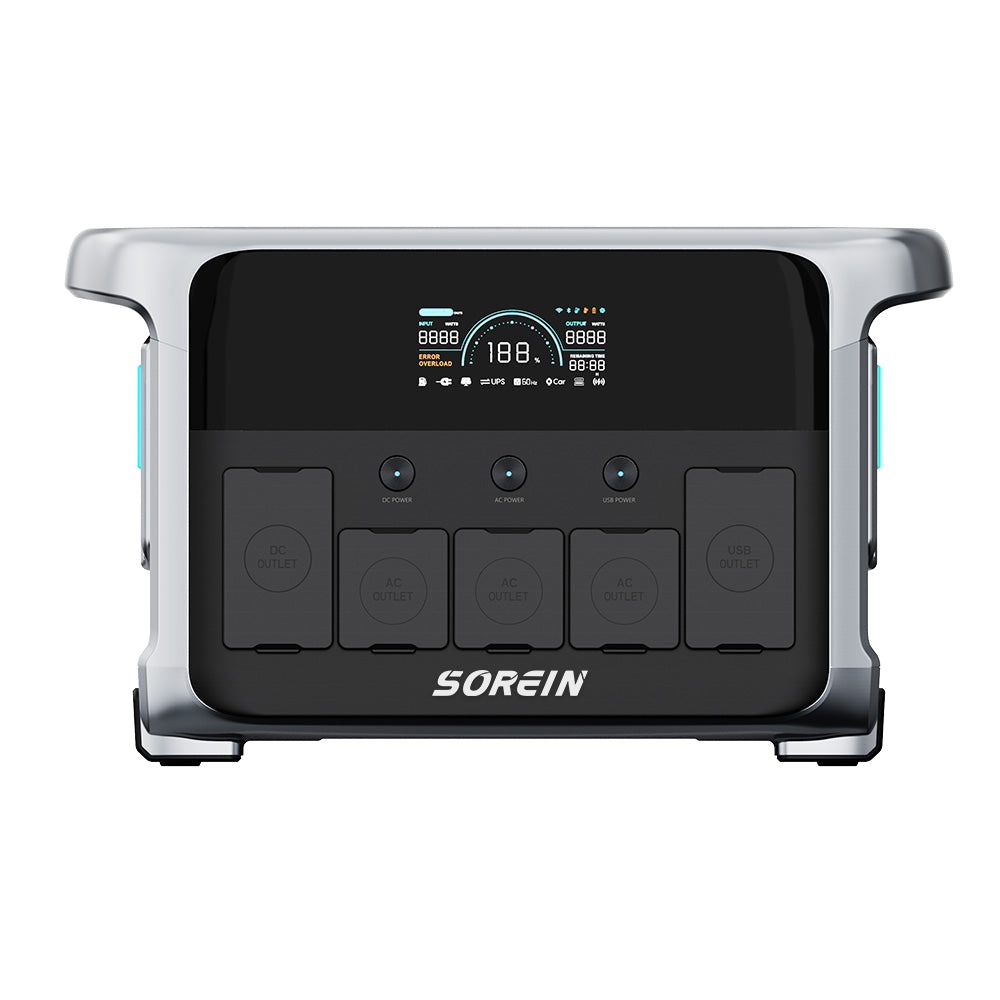
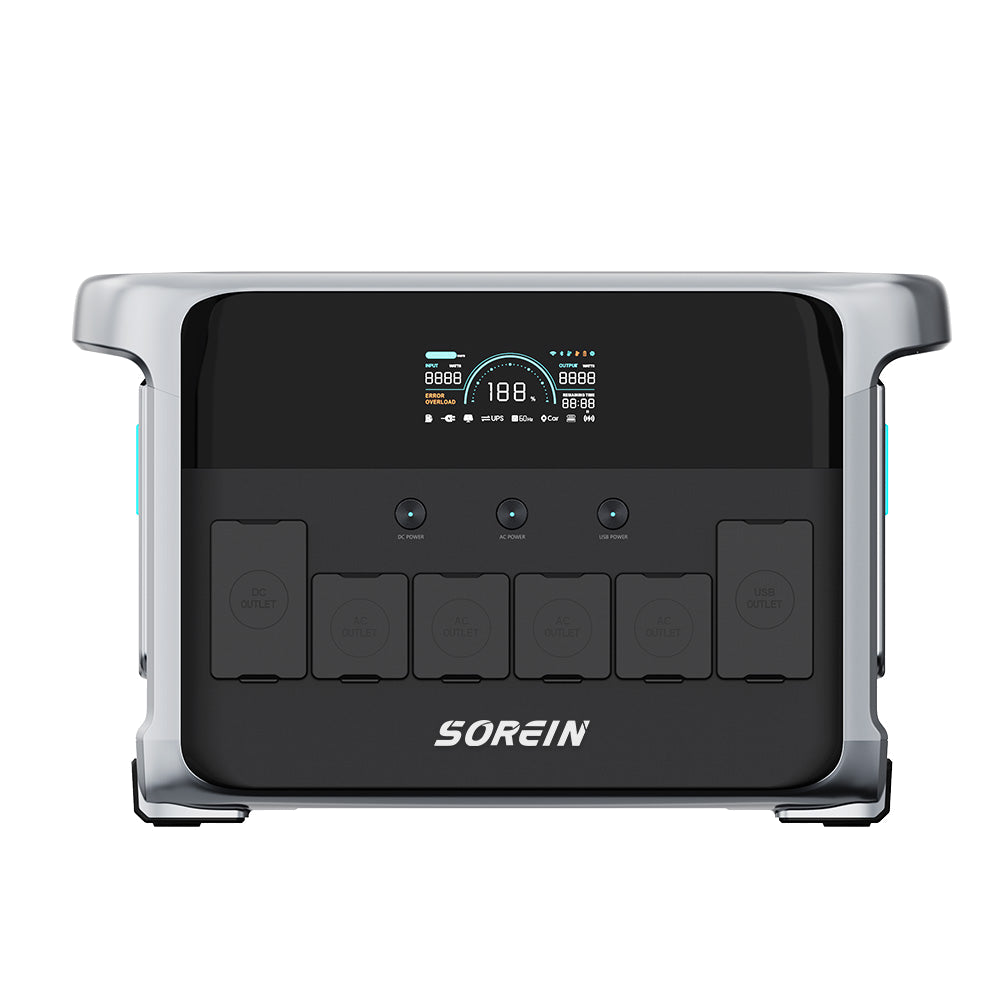
P600 and P1200 take either panel as the main charge; on P2400 and the G Series these panels are a daylight top-up, and the SP450 panel is the faster route.
More room for the weekend
P1200
A balanced step up for longer stays and appliances with moderate continuous draw.
Capacity
1,152Wh
AC output
1,200W
Best forHome outages, CPAP backup and mobile work — up to 1,200W
Straight answers on output, charging, weather, compatibility and care.
How much energy does a panel produce in a day?
About 1,120Wh from the SP400 and 1,260Wh from the SP450 on a typical strong day. The math is rated watts × peak sun hours × 0.7 real-world efficiency, and 4 peak sun hours is what clear weather usually gives you. Either number is a full P1200 refill with room to spare, or a P600 refilled twice over. Winter and overcast stretches cut both further.
Why doesn't my panel output its rated watts?
In good midday sun expect 300–340W from the SP400 and 340–385W from the SP450. Both labels are Standard Test Conditions ratings measured in a laboratory with 25°C cells. Real output depends on cell temperature, sun angle, shading and system losses — the full explanation sits above this section.
Do I need a separate charge controller?
No. Both panels feed a SoreinPower station's built-in MPPT charge controller. A separate controller is only needed when charging a raw 12V battery directly.
Can I run devices while the panel charges the station?
Yes. Most SoreinPower stations support pass-through use. Solar refills the battery while the station runs your devices, and the battery buffers the sun's variation either way.
Does it work on cloudy days?
Yes, at reduced input. Thin clouds and low-angle sun deliver 120–200W from the SP400 and 135–225W from the SP450; heavy overcast drops to 20–80W and 20–90W respectively. Either panel still contributes — it just stops being a same-day full-recharge plan for the larger stations.
How water-resistant are the panels?
Both carry an IP67 rating on the panel surface, so rain and splashes are covered. Do not submerge them, and keep connectors and cable ends dry. The folding seams and junction points are the parts to protect. Let the panel dry before folding it away.
How do I clean and store a panel?
Wipe the surface with a soft cloth and fresh water. Dust and pollen alone cut output 5–20%. Store it folded and dry, keep grit out of the folds and never pack sharp objects against the surface. The operating range is −20°C to 60°C.
Which stations should pair with these panels?
The P2400 and the G Series accept the full output of either panel, so nothing is capped and the SP450's extra watts actually land. The P600 stops at its 240W MPPT limit, which makes the 220W panel the sensible match there — a 450W panel would be flattened to 240W. The P1200 takes up to 400W, so the SP450 fits but gains little over the SP400.
Is one big panel better than two smaller panels?
For pure collection the energy is roughly the same — two 220W panels and one 450W panel harvest comparable watts, and panels wired in series add their voltage. One panel saves mounts, wiring and setup time, while a pair gives you aiming flexibility around obstacles and partial shade. See how the 220W folding solar panel pairs on its own page.
What are the dimensions and weight?
Both panels are the same sheet: unfolded 2,510 × 982 × 2 mm, folded 620 × 982 × 35 mm in a 4-fold layout, 14.4 kg net (18.4 kg gross). The IP67 ETFE surface and monocrystalline cells are built for repeated folding; keep the folds dry and free of grit to protect the hinges.
Should I buy the SP400 or the SP450?
They are the same panel with different cell batches, so the choice is about how much power you need from a fixed packing space. The SP450 returns 13% more rated power from the identical folded size and costs more per watt — the current gap is in the price table above. Pick the SP450 for a P2400 or any G Series station, where the full output is accepted; pick the SP400 when the station caps the input or when the difference goes unspent.
Does the SP450 work with the P1200?
Yes, and it charges slightly faster — but not by much. The P1200 accepts up to 400W of solar, while the SP450 peaks around 385W in real light, so it sits inside the ceiling rather than above it. Expect roughly 3.5–4.0 hours for a full charge in clear midday sun against 4.0–4.5 hours with the SP400.